




So, you've finally decided to take your French learning seriously. Maybe you're planning to move abroad, apply for a French-speaking university, or qualify for more job opportunities. Often, these goals require presenting a valid official French language proficiency test score. The problem is, there isn't just one French exam—there are several. TEF, TCF, DELF, DALF...which one do you actually need?
Each French exam serves a different purpose. Some are designed for immigration, while others are better for university admissions or proving your language skills for work. Understanding the differences can help you choose the right test from the start. In this guide, we'll explain TEF, TCF, DELF, and DALF in simple terms, who these tests are for, how they're scored, and when you should take them. By the end, you'll have a much clearer idea of which French exam is the right fit for you.
French Exams Explained: TCF vs TEF vs DELF vs DALF
When researching French proficiency tests, you'll likely encounter four names: TEF, TCF, DELF, and DALF. Although they all assess your French language skills, they're designed for different purposes. Understanding these differences is the first step in deciding which exam to take.
Here's a quick overview.
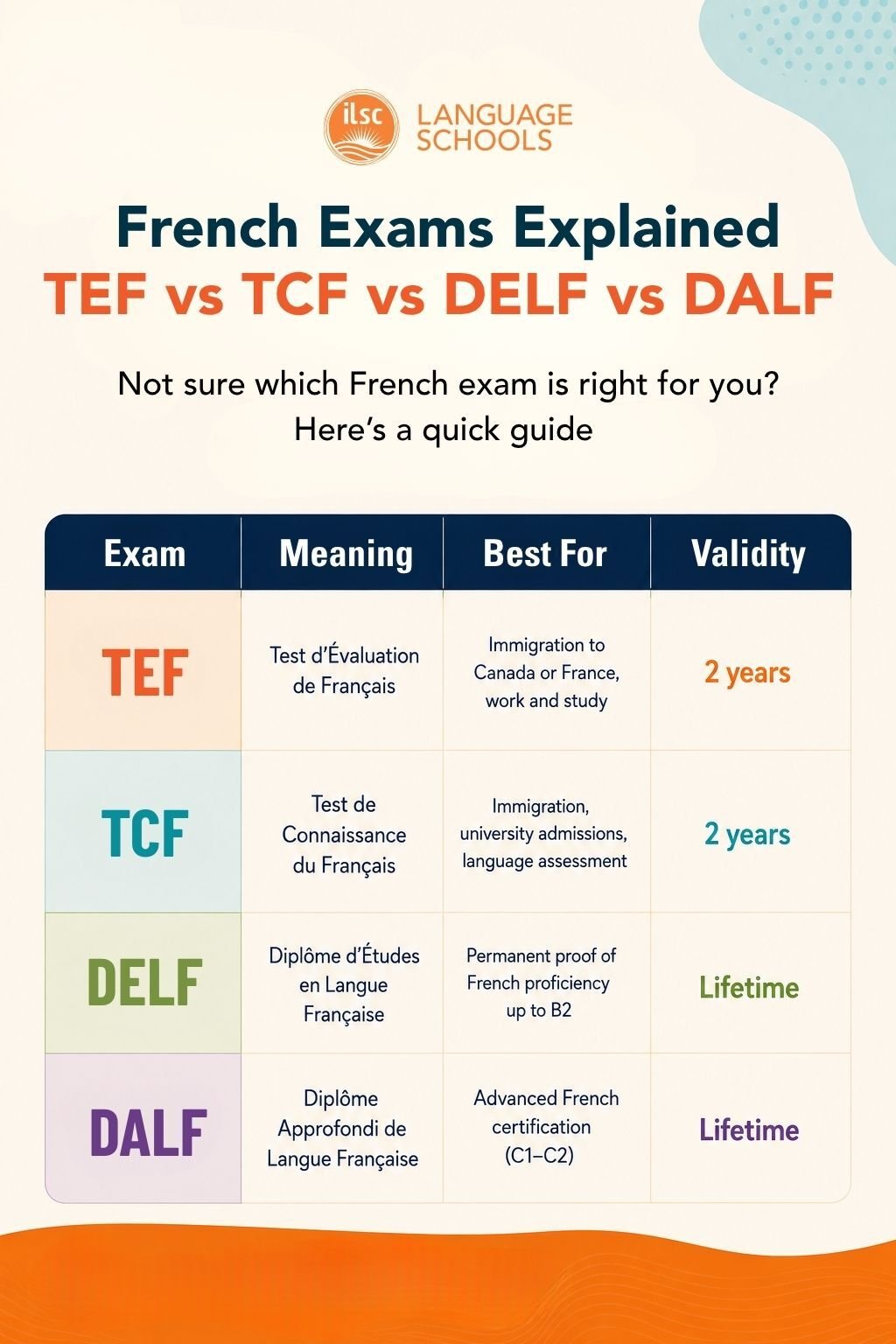
One of the biggest reasons people compare TCF and TEF is because both tests are accepted for Canadian immigration and other official purposes. However, they're administered by different organizations and have slightly different formats.
Meanwhile, DELF and DALF are diploma-style certifications rather than language assessment tests. Once you pass them, your certificate never expires, making them ideal if you want long-term proof of your French proficiency.
Let's take a closer look at each exam.
What is the TEF Exam?
The Test d'Évaluation de Français (TEF) is an internationally recognized French language proficiency test that measures your ability to understand and communicate in French across listening, speaking, reading, and writing.
People take the TEF for various reasons, including immigration, higher education, employment, and proving their French language proficiency. Different versions of the exam are designed for different goals, so it's important to choose the one that matches your application.
The TEF is recognized by governments, educational institutions, and employers around the world. TEF Canada is widely used for Canadian immigration, while TEFAQ (Test d'Évaluation de Français adapté pour le Québec) is accepted for certain Québec immigration programs.
What is the TEF used for?
The TEF can be used for:
- Canadian immigration through TEF Canada, which is accepted by Immigration, Refugees and Citizenship Canada (IRCC)
- Applying for French citizenship through the TEF Intégration, Résidence et Nationalité (TEF IRN)
- Studying at French-speaking universities or institutions that accept TEF scores
- Employment opportunities, especially with organizations that require proof of French proficiency
- Assessing your current French level for personal or professional development
What does the TEF evaluate?
The TEF evaluates five language skills:
- Reading comprehension
- Listening comprehension
- Speaking
- Writing
- Vocabulary and grammar
Some versions require all sections, while others only require specific modules.
How is the TEF scored?
Instead of receiving a pass or fail result, you'll receive a score that corresponds to the Common European Framework of Reference for Languages (CEFR), ranging from A1 to C2.
This allows immigration authorities, universities, and employers to determine your level of French proficiency.
Who should take the TEF?
The TEF is ideal for people who:
- Plan to immigrate to Canada
- Are applying for French citizenship
- Need French certification for university
- Need proof of French proficiency for work
- Want to assess your current French level
Things to Consider
TEF results expire after two years. If you're applying for immigration later, you may need to retake the exam.
What is the TCF Exam?
The Test de Connaissance du Français (TCF) is another internationally recognized French proficiency test. It was developed by France Éducation International on behalf of the French Ministry of Education.
Like the TEF, the TCF evaluates your current level of French. Both exams serve similar purposes and are accepted in many official processes.
What is the TCF used for?
The TCF may be required for:
- Immigration applications
- University admissions
- French nationality applications
- Employment
- Personal language assessment
What does the TCF evaluate?
The TCF evaluates:
- Listening
- Reading
- Speaking
- Writing
- Grammar and language structures
How long are TCF results valid?
TCF results remain valid for two years. This makes it suitable for applications with immediate deadlines but less ideal if you're simply looking for a permanent language qualification.
Things to Consider
Your certificate expires after two years, meaning you'll need to retake the exam if your results are no longer valid when applying for immigration or university.
What is the DELF Exam?
The Diplôme d'Études en Langue Française (DELF) is an official French language diploma awarded by the French Ministry of Education. Unlike the TEF and TCF, which assess your current French proficiency, the DELF is a certification that proves you've reached a specific language level.
One of the biggest advantages of the DELF is that it's valid for life. Once you pass an exam level, you don't need to retake it or renew your certificate.
What is the DELF used for?
The DELF is commonly used for:
- University admissions
- Employment opportunities
- Studying abroad
- Personal achievement
- Proof of French proficiency
What does the DELF evaluate?
The DELF evaluates four core language skills:
- Listening
- Reading
- Writing
- Speaking
Unlike the TEF or TCF, each DELF exam corresponds to a specific CEFR level. You choose the level you're ready for before taking the exam.
DELF levels
The DELF consists of four independent levels:
| Level | Description |
| A1 | Beginner |
| A2 | Elementary |
| B1 | Intermediate |
| B2 | Upper intermediate |
If you pass one level, you earn that diploma for life. You can then choose to take the next level whenever you're ready.
Who should take the DELF?
The DELF is ideal for learners who:
- Want a lifetime French qualification
- Need French certification for university
- Want to strengthen their CV
- Plan to study or work in a French-speaking environment
- Want to measure their progress over time
Things to Consider
Since each DELF exam targets a specific level, you'll need to choose the exam that matches your current ability. If you want to earn a higher certification later, you'll need to take another DELF exam for the next level.
What is the DALF Exam?
The Diplôme Approfondi de Langue Française (DALF) is the highest level of official French certification awarded by the French Ministry of Education. It's intended for advanced learners who can communicate confidently in academic, professional, and everyday settings.
Like the DELF, the DALF is a diploma that's valid for life.
What is the DALF used for?
The DALF is commonly used for:
- University admissions
- Professional careers
- Working in French-speaking countries
- Advanced proof of French proficiency
Many French universities exempt DALF C1 or C2 holders from additional language requirements because the diploma demonstrates advanced language competence.
What does the DALF evaluate?
The DALF assesses your ability to:
- Understand complex written texts
- Follow advanced spoken conversations
- Write detailed and well-structured responses
- Speak fluently in formal and informal situations
DALF levels
The DALF consists of two advanced levels:
| Level | Description |
| C1 | Advanced |
| C2 | Proficient/Near-native |
These exams require strong comprehension, critical thinking, and the ability to express complex ideas in French.
Who should take the DALF?
The DALF is ideal for those who:
- Have advanced French skills
- Plan to study at a French university
- Want to work professionally in French
- Need an advanced lifetime certification
Things to Consider
The DALF is significantly more challenging than the DELF because it assesses advanced language skills. Most learners spend several years studying French before attempting the C1 or C2 exams.
So, Which French Exam Should I Take?
The best French exam depends on what you need it for.
Comparing TCF vs. TEF? Both exams assess your current French proficiency and are commonly used for immigration, work, and study applications. In most cases, your choice will depend on the requirements of the institution or organization you're applying to.
For a certification that never expires, the DELF or DALF is the better option. These diplomas provide lifelong proof of your French proficiency, making them a great choice for university admissions, career opportunities, or personal achievement.
Here's a quick guide to help you decide:
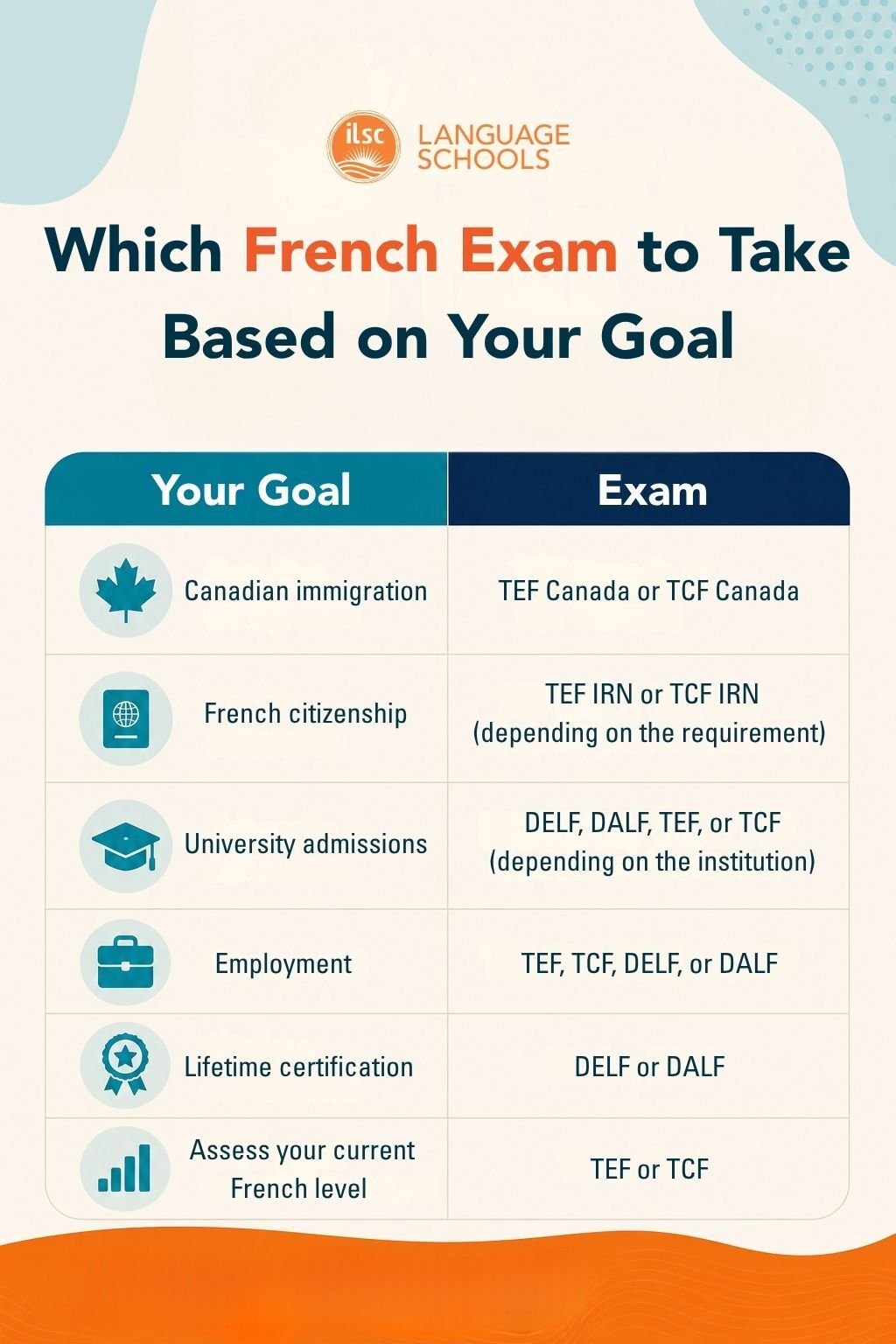
The best exam is ultimately the one that aligns with your goals. Once you've identified why you need a French certification, choosing the right test becomes much easier.
Master Your French and Prepare for French Exams with ILSC Language Schools
Whether you're preparing for the TEF, working toward the DELF or DALF, or simply building your confidence in French, ILSC Language Schools can help you reach your goals. ILSC Language Schools offers French language courses for learners of different proficiency levels, including a dedicated TEF Preparation Program to help you prepare for the exam. Prefer learning from home? With ILSC ALLO, you can take interactive French classes online and learn at your own pace.
This is a general guide to the differences between the TEF, TCF, DELF and DALF. To confirm which test you should take, which test version is accepted, and which components you need to complete, always check the current requirements with the relevant immigration authority, higher education institution, employer, or other organization requesting proof of French proficiency.
Frequently Asked Questions About French Exams
Which French exam is the easiest?
There's no single "easiest" French exam because each one is designed for a different purpose. Neither test is officially easier than the other—they simply have different formats and question styles. Meanwhile, the DELF and DALF assess specific proficiency levels, so the difficulty depends on the level you choose. For example, DELF A1 is much easier than DALF C2 because they're intended for different stages of language learning.
Does Canada accept DELF?
Yes, Canada recognizes the DELF as proof of French language proficiency in many academic and professional settings. However, if you're applying for Canadian immigration, you'll typically need to take an approved language test such as TEF Canada or TCF Canada, as DELF scores are generally not accepted for immigration applications.
How difficult is TEF in Canada?
The difficulty of the TEF Canada depends on your current French proficiency. The exam evaluates your listening, reading, speaking, and writing skills using real-life situations. Some test takers might find it challenging to demonstrate their skills under timed exam conditions. The good news is that with consistent practice and proper preparation, many candidates achieve the scores they need. Taking mock exams, improving your vocabulary, and enrolling in a TEF preparation course can help you feel more confident and relaxed on test day.
Is DELF internationally recognized?
Yes. The DELF is internationally recognized and awarded by the French Ministry of Education. Universities, employers, and institutions around the world accept it as official proof of French language proficiency. Since it's a diploma rather than a language assessment test, your DELF certification remains valid for life.